
Riverfront Homes: The Application of Design and Lifestyle Guides to Wealth Building
Financial independence does not just equate to a figure. It should be seen in terms of building a life that may be in tandem with the freedom to make choices and long-term satisfaction. A lot of full-fledged design and lifestyle guides focus on purposeful choice of assets, conscious consumption and tactical ownership. In this post, the purchase of a riverfront house in District 9, Singapore is not just something about luxury, but a good architecture of life.
In global cities which are stable and in a good position, prime real estate can be used as a home and a cornerstone investment. Such a property represents a combination of personal welfare and capital conservation when considered carefully. And, daily life is oriented on the larger objectives of financial self-sufficiency.
District 9: A Good Strategic Location in the Long Run
District 9 is a part of the Core of Central Region of Singapore, which boasts of:
- Accessibility to Orchard road and high commercial areas
- Good expatriate rental market
- Established infrastructure
- Limited land supply
Scarcity drives resilience. To those seeking to achieve financial freedom, long-term asset longevity is of greater importance than short-term speculation. Prime districts have been shown to have consistent appreciation with time over time as opposed to fringe locations especially where the economy is stable.
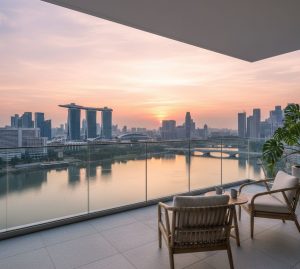
The central riverfront location ownership minimizes the risk of geographic dependency, but the liquidity potential of resale markets is maintained.
Creating a Home That Makes Work and Life Balanced
Monetary freedom tends to encompass lax working arrangements, remote entrepreneurship, portfolio administration, consulting, or passive earnings management. The activities can be directly supported by a well-planned riverfront house.
Survival in Darkness and Intelligence
Massive windows and arrangements that face rivers enhance natural lighting which studies show will relate to better mood and output.
Multi-Functional Interiors
There is a smooth transition of work, leisure, and entertaining in open-plan residential areas that eliminate the use of external workspace costs.
Wellness-Oriented Amenities
Gyms, gardens and waterfront walkways promote physical fitness without having to pay subscription fees elsewhere.
When a home augments day-to-day effectiveness, it lowers stress in occupational and existence management.
Real Estate: A Stability Anchor and Asset Allocation
In asset allocation planning and wealth management theory, like FIRE (Financial Independence, Retire Early), asset allocation is the focus. Real estate in politically stable city with economically developed cities is selling:
- Inflation-hedging characteristics
- The possible sources of rental income
- The value of capital in the longer periods of holding capital
- Non-equity portfolio diversification
In this case, riverfront properties are known to be intrinsically premium concerning lifestyle as they are limited in supply. Waterfront positioning is nonrenewable, which supports the strength of long-term values. To a financial independent who does not need to earn money, a constant cash flow and safety of capital is just as good as growth potential. Prime urban property can do both when it is prudently purchased.
Lifestyle Inflation vs. Planned Upgrade
One of the major difficulties of the wealth-building journeys is the ability to differentiate between lifestyle inflation and strategic lifestyle investment. The distinction is in congruence.
- Lifestyle inflation is empty consumption.
- Planned upgrading is investment, which improves the quality of life and the strength of assets.
The latter may be the case of a riverfront house in District 9 when evaluated by disciplined budgeting and long-term holding approach. The property serves:
- As a personal residence
- As a legacy asset
- This being a potential revenue-generating entity
- As a geographic diversification vehicle
The choice has to be made based on financial ratios, measurement of opportunity cost, and long term planning- and not emotional impulse.
Reducing Hidden Costs through Effective Planning
Cost awareness also plays a major role in financial independence planning. The prime developments may include:
- Environment-friendly building system
- Sturdy materials which minimize maintenance costs over the long run
- Combined security infrastructure
- Efficiency in centralized management
Financial surprises are reduced because of operational predictability. Under regulated urban settings such as Singapore, the uncertainty will diminish over time due to the presence of maintenance systems and clarity in regulations.
Diversifying in Wider Financial Independence Plans
There are posts that could be of interest to the readers willing to fortify their path to autonomy. Those resources may focus on the following areas:
- Frameworks of passive income and diversified portfolios
- Integration of real estate through strategies employing FIRE
- Lifestyle creep and how to manage it and grow net worth
- Capital principles of compounding in the long term
These arguments express supplementary insights when looking at property as part of an all-encompassing independent pathway.
Conclusion: Making Residence the Long-term Freedom
A house, located on a riverfront, in District 9 is an intersection of dreams and reason. It may also serve as a refuge and tactical resource through rigorous financial planning and deliberate ownership. The guides on design and lifestyle always focus on alignment. It is to make sure that the key choices in life do not undermine freedom but support it in the long run.
In a steady global metropolis where supply of prime land is minimal, strategically purchased property may aid in capital increase, day-to-day and intergenerational prosperity. It comes down to deliberate organization to be financially independent. Wealth is not only accumulated, but lived, when the values of residence, investment strategy, and lifestyle are in accord.